Documentation · 6 min read
What Makes a Chiropractic SOAP Note Actually Defensible?
You finish a busy afternoon. Every patient has a SOAP note. All four boxes are filled. You documented pain, palpation, an assessment, and treatment.
That means the note is complete. It does not automatically mean the note is defensible.
A complete note tells someone what you recorded. A defensible note helps someone understand why your clinical decisions made sense for that patient, on that date.
That difference matters when a payer reviews repeated visits or an attorney examines a personal injury file months later. They were not in the room. Your record has to explain the visit without you standing beside it.
There is no magic sentence that makes a note legally bulletproof. Requirements vary by payer and jurisdiction. But three practical elements make chiropractic documentation easier to evaluate: medical necessity linkage, patient-specific detail, and consistency across the record.
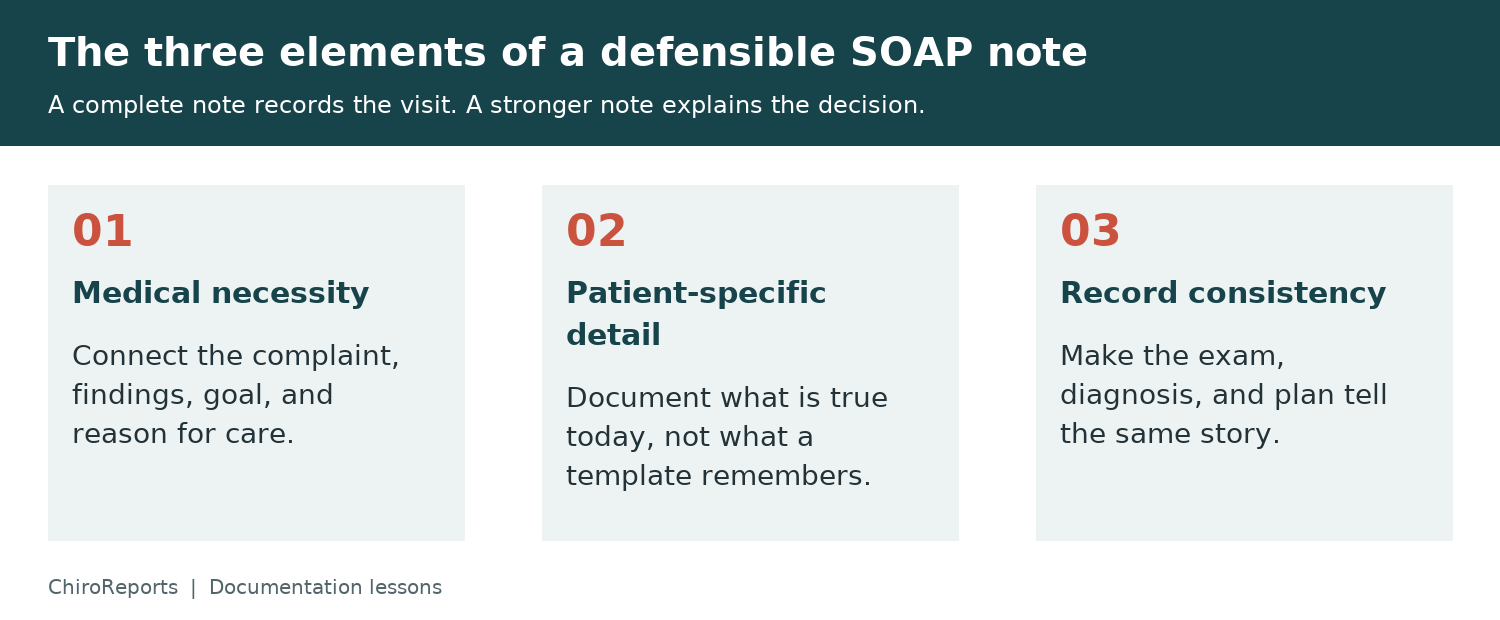
1. Medical necessity: connect the finding to the reason for care
“Cervical tenderness. Adjustment performed.”
That records a finding and a service. It leaves the important part unexplained: why was that service reasonable today?
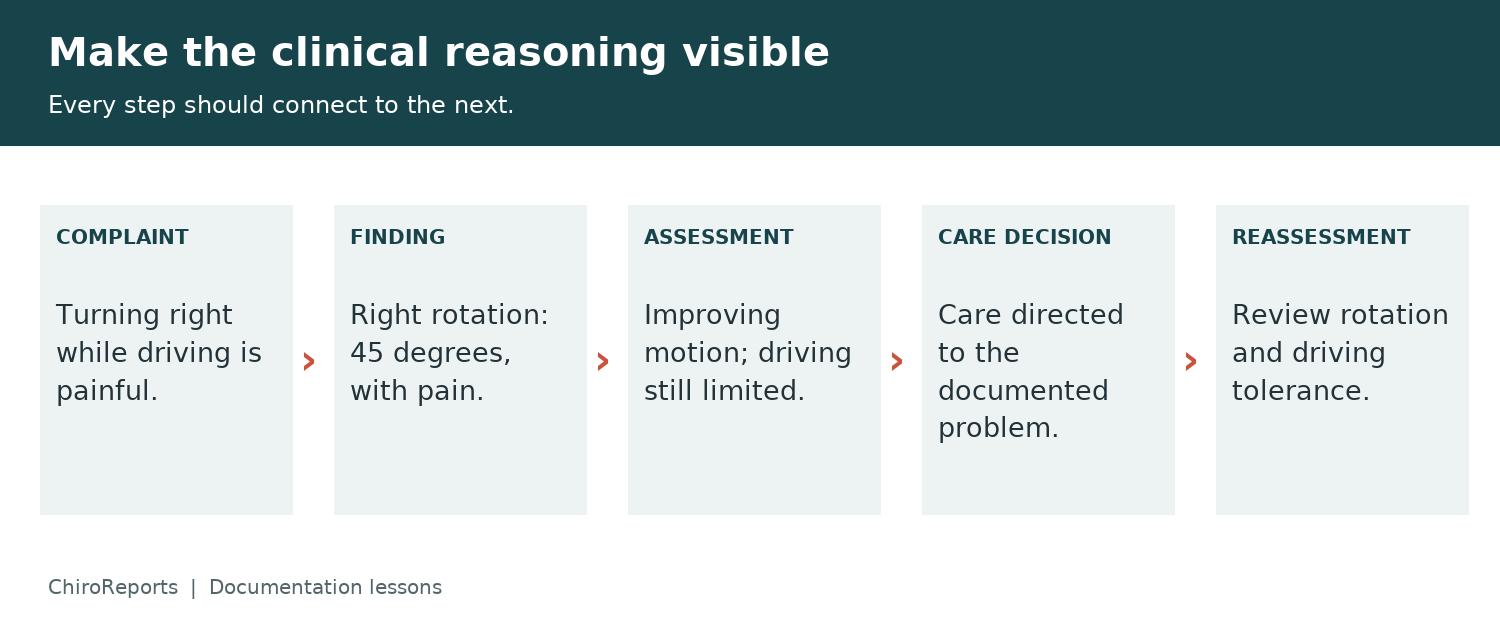
Medical necessity is not established by collecting more findings. It is supported by connecting the patient's complaint, relevant examination findings, your assessment, and the treatment decision.
Think of it as a short chain:
- What problem is affecting the patient?
- What did you find that helps explain it?
- What are you trying to improve?
- Why does today's care fit that goal?
- What will tell you whether the plan is working?
“Neck pain” is a complaint. “Neck pain limits checking the blind spot while driving” gives it functional meaning.
“Rotation restricted” is a finding. “Right cervical rotation is 45 degrees and reproduces the patient's right-sided neck pain” gives the reader something concrete to connect to that complaint.
Then your assessment can explain the relationship. You are treating a documented cervical problem that continues to interfere with driving, not simply treating because tenderness exists.
A useful goal might be checking the blind spot without pain-related hesitation. If you measure rotation, use a consistent method and compare it at appropriate reassessments. Do not invent a measurement because the template has a blank.
For Medicare chiropractic care specifically, CMS guidance describes documenting symptoms, examination findings, diagnosis, a treatment plan with measurable goals, and subsequent assessment of progress. Those are Medicare requirements, not a universal checklist for every personal injury case.
The broader lesson travels well: show the clinical reason for care and how you are evaluating the response.
2. Specificity beats copy-paste chiropractic documentation
Templates are not the enemy. Unsupported sameness is.
A template can remind you to record the right things. It becomes a problem when yesterday's findings appear in today's note without being checked.
“Patient improving. Continue treatment.”
Improving how? Pain? Sleep? Walking tolerance? Ability to work? And if the patient is improving, why is the same visit frequency still appropriate?
Compare that with:
“Patient reports neck pain decreased from 6/10 to 4/10 since the previous visit. Still avoids turning fully right when driving. Right cervical rotation remains painful at 45 degrees. Continue the current short-term plan and reassess driving tolerance and rotation at the next scheduled review.”
You can hear the patient in that note. You can also hear the clinician making a decision.
Specificity does not mean documenting every possible negative finding at every visit. It means recording the details that actually support the assessment and services performed.
Useful specifics include:
- Side and body region, when relevant.
- A meaningful functional limitation.
- A measured finding or clearly described observation.
- What changed, what did not, and what that means for the plan.
Do not write “neurologically intact” unless the examination you actually performed supports that statement. Do not carry forward “no headaches” when the patient reported a headache today.
If information came from the patient, say so. If you observed or measured it, make that clear. Reported and observed findings can both matter, but they are not interchangeable.
In personal injury work, be especially careful with timing and causation. “Patient reports symptoms began after the collision” records the history. A clinical opinion about causation needs its own reasoning. The timing alone does not prove the relationship.
3. The exam, diagnosis, and treatment plan must tell one story
A good daily note cannot rescue a contradictory file.
Imagine an examination describing localized neck pain without arm symptoms. The diagnosis list says cervical radiculopathy. The treatment plan focuses on the lumbar spine. Nothing explains the mismatch.
Maybe there is a legitimate reason. Maybe additional findings exist elsewhere in the record. The reviewer should not have to guess.
Consistency means the record's pieces fit together:
- Examination findings support the clinical assessment.
- Diagnosis codes accurately reflect supported diagnoses.
- The plan addresses the documented problems and functional goals.
- Follow-up notes explain progress, setbacks, and changes in care.
Do not select a more serious diagnosis simply because it sounds stronger. Neck pain alone does not establish radiculopathy. A code lookup helps you find a code; it does not establish the diagnosis for you.
For injury codes that require an encounter character, verify the applicable ICD-10-CM guidance. “Initial encounter” is not automatically the first visit to your office. Active treatment versus routine healing matters, and the correct character depends on the circumstances.
Consistency also does not mean identical findings forever. Patients change. A new complaint, a revised diagnosis, or a different plan can be entirely appropriate. Document what changed and why.
For personal injury records, keep the chronology understandable. Identify relevant prior symptoms and distinguish the patient's account from your conclusions. If you correct an entry, follow applicable amendment requirements and preserve the original record rather than silently rewriting history.
Before and after: the same visit, documented differently
This fictional example shows the difference between a generic note and one that explains the visit. The added facts illustrate what to document when true. They are not facts to paste into a real chart.
| SOAP section | Weak note | More defensible note |
|---|---|---|
| Subjective | Neck pain. Doing better. | Patient reports right-sided neck pain decreased from 6/10 to 4/10 since the previous visit. Turning right to check the blind spot remains painful. No new arm symptoms reported. |
| Objective | Tenderness and decreased ROM. | Right cervical rotation measured at 45 degrees and reproduces right-sided neck pain. Right cervical paraspinal tenderness on palpation. Rotation was 35 degrees at the prior reassessment. |
| Assessment | Cervical dysfunction. Improving. | Neck pain with improving right rotation, but persistent pain-related limitation while driving. Findings support continued attention to the cervical complaint; response to care will be reviewed at the planned reassessment. |
| Plan | Adjust. Continue 3x/week. | Cervical manipulation performed as specified in the treatment entry, with no immediate adverse response observed. Continue previously prescribed pain-free cervical mobility exercise. Reassess rotation and driving tolerance in one week; reconsider frequency based on progress. |
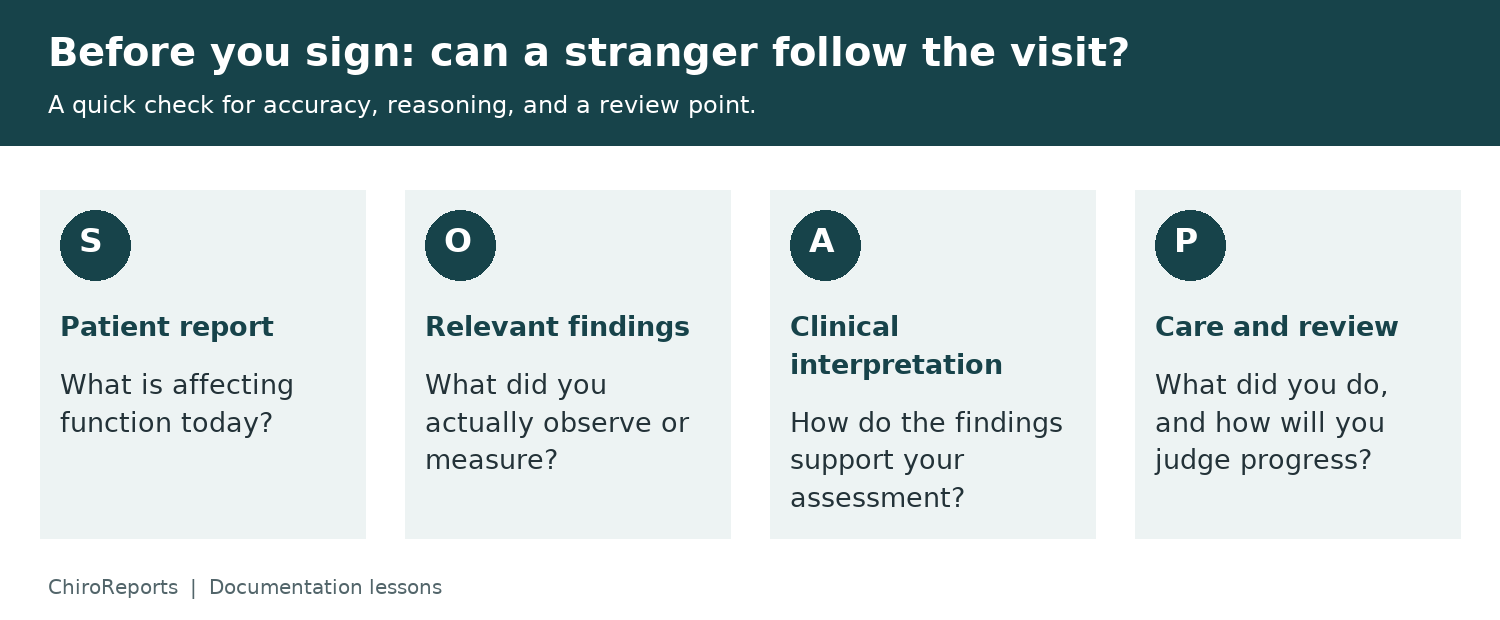
Notice what changed. The stronger version does not drown the reader in terminology. It supplies a functional problem, a comparable finding, a clinical interpretation, and a review point.
It also avoids approving three visits a week simply because that frequency appeared in the previous note. Actual service details still belong in the record. This teaching excerpt does not replace required documentation of the treatment delivered, consent, coding, or other applicable requirements.
A quick check before you sign
Read the note as someone who has never met your patient.
Can you identify the problem being treated? Can you see why today's findings support the assessment? Does the plan follow from that assessment? Is there a way to judge progress?
If the answer is no, add the missing clinical connection, not another paragraph of boilerplate.
Defensible SOAP notes in chiropractic are not about writing more. They are about making your reasoning visible, while staying accurate about what you actually asked, observed, and did.
ChiroReports helps you turn structured clinical findings into clear reports that support that same documentation mindset.
Sources and scope
This article is educational, not legal advice or a guarantee of payment or defensibility. Check current payer rules, your state requirements, and the official ICD-10-CM guidelines for your setting.
Spend less time on paperwork.
Start Free